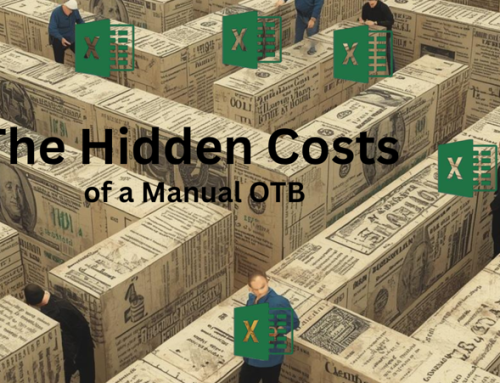






Why MFP and OTB break down in fast‑turning retail. Across the industry, one idea holds true: “retail is retail.” Whether you’re moving potato chips, denim, footwear, or edibles, the core mechanics of Merchandise Financial Planning (MFP) and Open‑to‑Buy (OTB) don’t change.
And it’s true.
MFP is the numerical strategy roadmap behind your categories—your roadmap for inventory investment. It helps retailers proactively forecast what they need, when they need it, and how much capital to allocate. Considering inventory is typically a retailer’s largest use of cash, getting this right matters.
OTB then becomes your in‑season steering wheel, helping you correct course as trends, sales, and demand shift.
But here’s where the real challenge hits:
Modern Retail Moves Fast for spreadsheets—Excel Just Can’t Keep Up
Many fast‑turning retailers still rely heavily on spreadsheets to manage both MFP and OTB. And while Excel is familiar, flexible, and universal… it’s also becoming a major operational bottleneck.
If your business experiences any of the following, Excel starts to collapse under the weight:
v High SKU churn
New items dropping in and out of the assortment every week? Suddenly, your “simple” workbook is 20 tabs deep and takes days just to update.
v Rapid category turnover
Short product lifecycles demand short planning cycles—something spreadsheets aren’t built to handle efficiently.
v Weekly demand volatility
Weather, events, promotions, social trends… volatility makes Excel forecasting reactive instead of proactive.
v Multi-store differences
When every store behaves differently, planners end up maintaining dozens (or hundreds) of store‑level files.
v Location‑by‑location performance variability
Excel can’t easily support localized demand. High-performing stores sell out. Lower-performing ones sit on inventory.
v Heavy operational reliance on Excel
Broken formulas, version control issues, manual reporting, and tribal knowledge living in individual files… the risks add up.
The Result? A Great MFP Strategy That’s Impossible to Execute at Scale
The principles of MFP and OTB haven’t changed.
But the pace of retail has.
Fast‑turning businesses need tools and processes that are:
v Predictive
v Automated
v Scalable
Otherwise, teams end up spending time updating spreadsheets instead of planning the business.
Enter daVinci’s MFP + In‑Season OTB
A modern approach that gives planners what Excel never will:
1. A Proactive, Category‑Level Inventory Management
Identify inventory needs earlier, reduce missed margin, and build strategies rooted in data—not gut feel.
2. Seamless Connection Between Long‑Range Plans & In‑Season Action
Your MFP doesn’t just sit in a binder—it translates directly into real‑time OTB execution.
3. Huge Productivity Gains
Move teams out of manual spreadsheet gymnastics and into a platform that’s automated, accurate, and built for the pace of today’s retail.
Final Thought
Merchandise Financial Planning and Open to Buy principles haven’t changed.
But retail has.
And so must the tools.
If Excel is slowing down your planning, forecasting, or in‑season execution… you’re not alone—and you’re not stuck.
Related Product
daVinci Merchandise Planning
daVinci Retail’s merchandise planning solution enables retailers to build strategic financial plans which guide buy decision-making to deliver sales and margin goals.